

Capture statuses
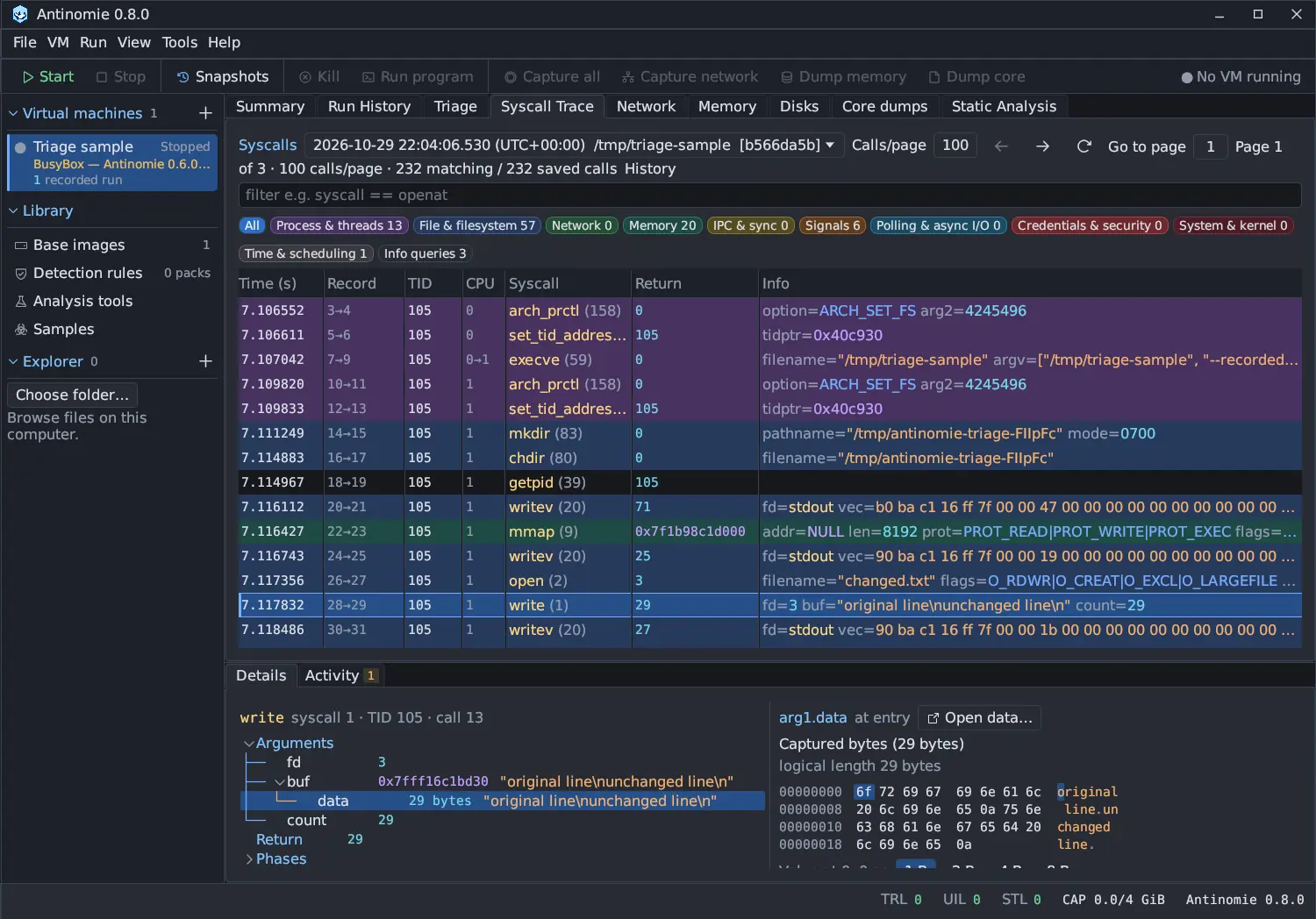
Every captured field, a string, a buffer or a structure, carries a status that says
how completely the recorder obtained it. Syscall Trace shows it next to the field,
and you can filter on it with args.<argument>.status (see
Syscall Trace filter).
The recorder copies user memory without faulting pages in, so it never changes the program’s behavior. That is why some fields cannot be complete. A missing value is not an empty one.
Since 0.7.1, with a base built for 0.7.1 or later, an input that was NOT_RESIDENT at the call’s entry is read again when the call returns. The field then takes the place of the NOT_RESIDENT one, with an at exit tag whose tooltip says the bytes are what memory held after the call (another thread could have changed them meanwhile). After a successful exec, the path, arguments and environment come from the kernel’s copy and the new program’s stack, tagged kernel copy. Such a call is no longer incomplete.
The six you will meet most
Section titled “The six you will meet most”| Status | In plain words | What to do |
|---|---|---|
| COMPLETE | All the bytes were captured | Nothing; the value is whole |
| NOT_RESIDENT | The memory is mapped and readable but the page had not been loaded yet, so nothing could be copied without faulting it in. The kernel loaded it for the call itself. | The value is unknown, not empty. Look at later calls, or check the strings the program passed elsewhere. |
| COPY_FAULT | The bytes could not be read: the address was not mapped, not readable, or the recorder could not safely check | The value is unknown. A call with a bad pointer may legitimately have failed with EFAULT. |
| INVALID_EXTENT | The length the program gave was invalid or above the kernel’s limit, so no bytes were copied | The program passed a bad size. Read its declared length instead. |
| ADDRESS_ONLY | Only the address and length were recorded, never the contents | Expected for another process’s memory, such as ptrace or process_vm_readv targets |
| NO_DECODER | The recorder has no rule for this argument, selector or option | The value may be recorded raw; see Known gaps |
NOT_RESIDENT, COPY_FAULT, INVALID_EXTENT and NO_DECODER mark the call as
incomplete. COMPLETE, ADDRESS_ONLY and a null or not-written field do not.
Copy faults, schema gaps and context failures are also counted under More health
details in Summary; they are diagnostics and are not added to the packet-loss
counters.
The other statuses
Section titled “The other statuses”| Status | Meaning |
|---|---|
| Unknown extent | The length could not be determined |
| Null pointer | The argument was a null pointer |
| Not observed asynchronously | The kernel reads this later, in a context where user memory could not be read safely (see Async observations) |
| Resource exhausted | The recorder ran out of staging space for this field |
| Aborted on loss | The capture was abandoned because records were being lost |
| Context missing | The context needed to read the value was not available |
| Not written | An argument the kernel ignores and never writes, such as the cache argument of getcpu. Nothing is missing, and the call is not marked incomplete. |
A note on timing
Section titled “A note on timing”Memory can change while it is being read. A recorded buffer is what the memory held when the kernel copied it, which is not an atomic snapshot of the program.