

What's new in 0.8.0
Antinomie 0.8.0 is in development on the release-0.8.0 branch and is not
released yet; the current release is 0.7.1. This page lists what 0.8.0
adds so far. The release notes summarise
every version, and the product’s
CHANGELOG.md
has every item.
Samples and custody
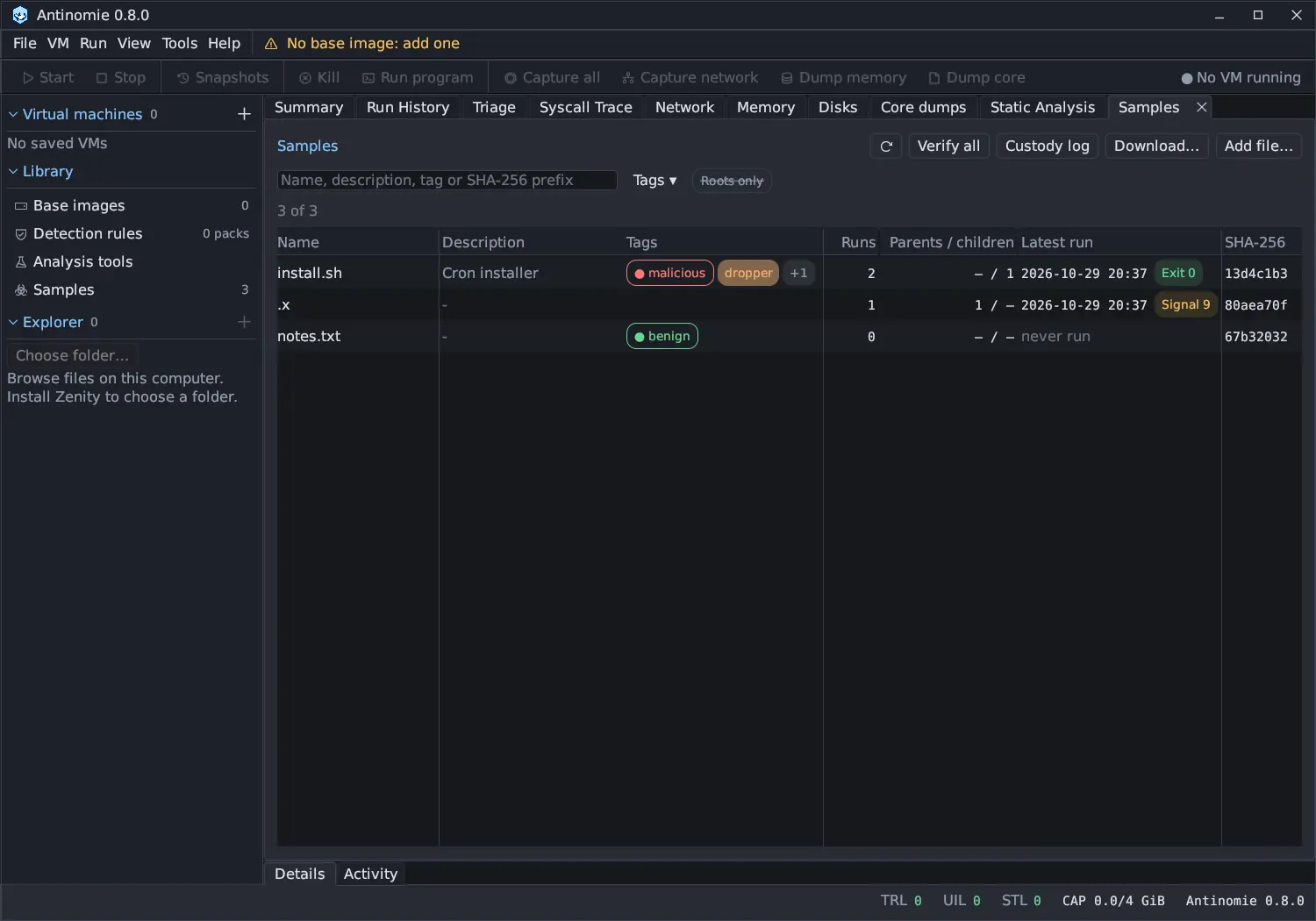
Section titled “Samples and custody”- Library › Samples lists every sample across runs and VMs: name,
description, tags, run count, parents and children, latest run and SHA-256,
with search, a tag filter and Roots only. Add file… hashes a file
without running or unpacking it. Everything uploaded into a VM is archived
first, as an encrypted zip with the password
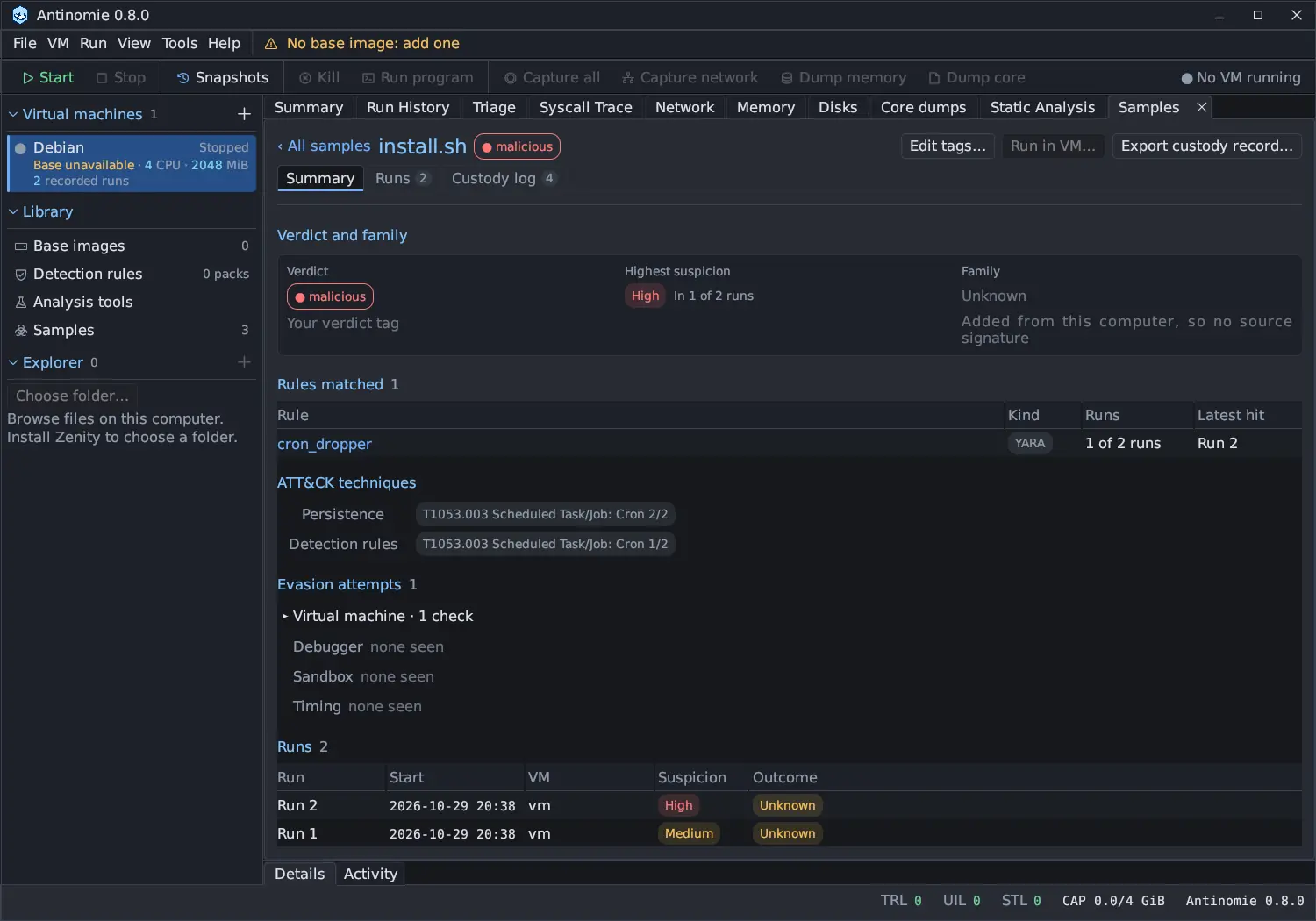
infected. - A sample has its own window, with Summary, Runs and Custody log tabs. The Summary adds up Triage over the sample’s runs (highest suspicion, rules matched, ATT&CK techniques, evasion attempts, indicators), and has a lineage graph, a file viewer, the runs’ output files and similar samples by TLSH distance.
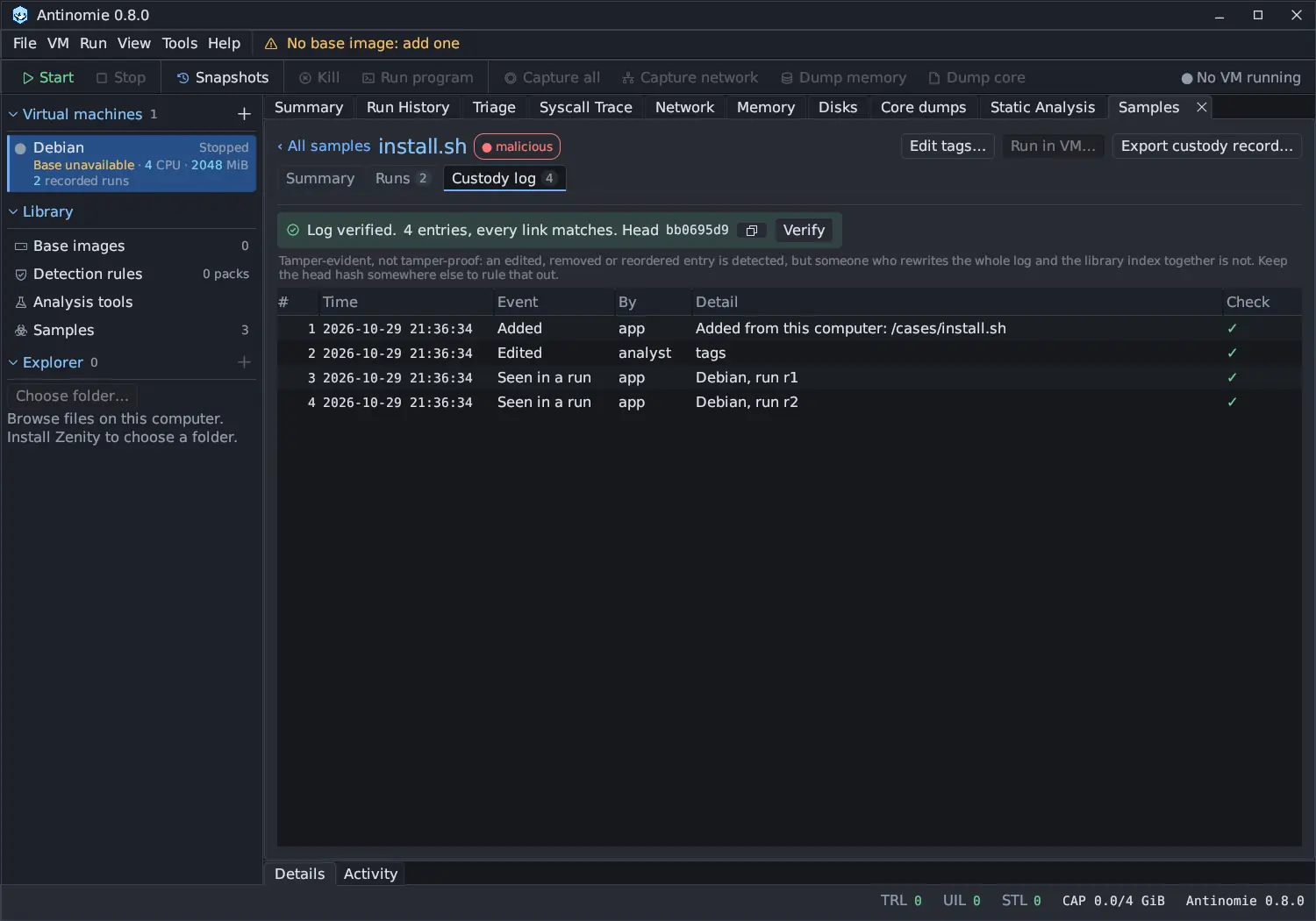
- A custody log chains everything done to or by each sample by SHA-256, so an edited, removed or reordered entry is found. Export custody record… writes JSON or HTML, optionally signed with your own minisign or SSH key.
Read The sample library, The sample window and Custody log.
Report export and evidence bundle
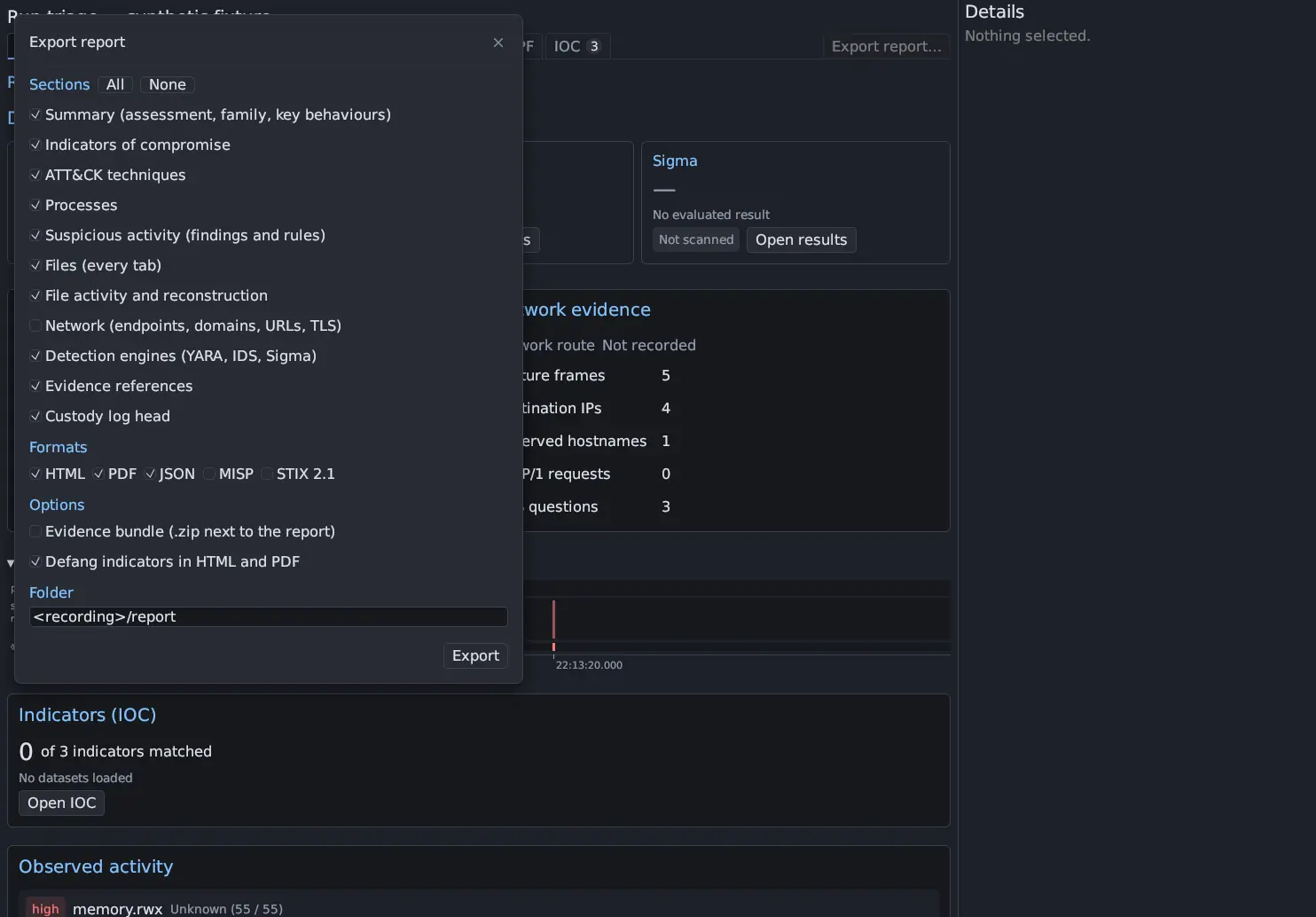
Section titled “Report export and evidence bundle”Triage › Export report… writes the whole run as HTML, PDF, JSON
(a versioned schema), a MISP event or a STIX 2.1 bundle, with a
checkbox per section. The report covers the whole run, whatever the tables are
filtered to. An optional evidence bundle holds the packet captures, the
files the run dropped in an inner AES-256 zip (password infected), the
sample’s custody record and a SHA-256 manifest. Defanging applies to HTML and
PDF only. Nothing in a report is a verdict.
See Report export and evidence bundle.
File evidence and File Reconstruction
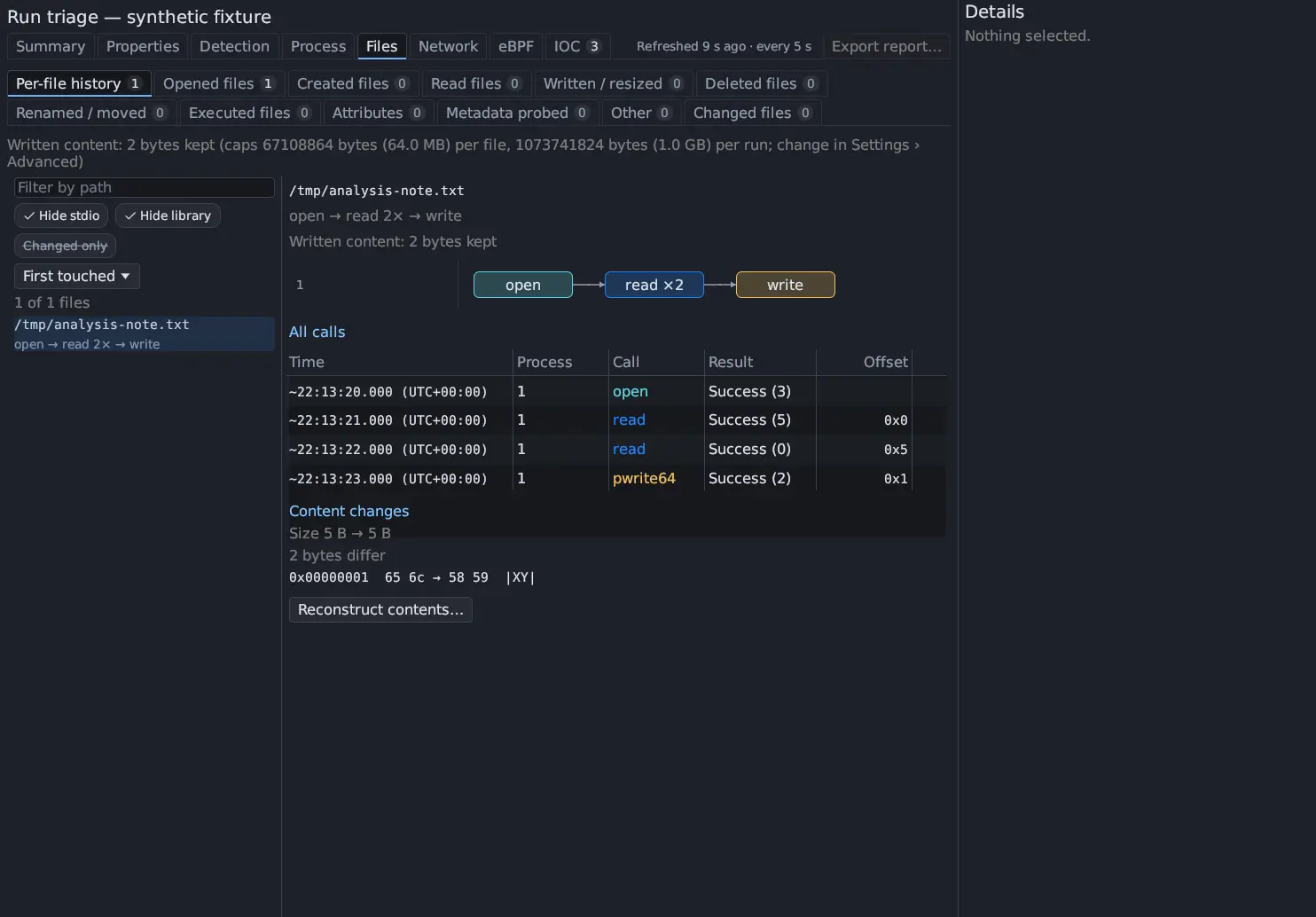
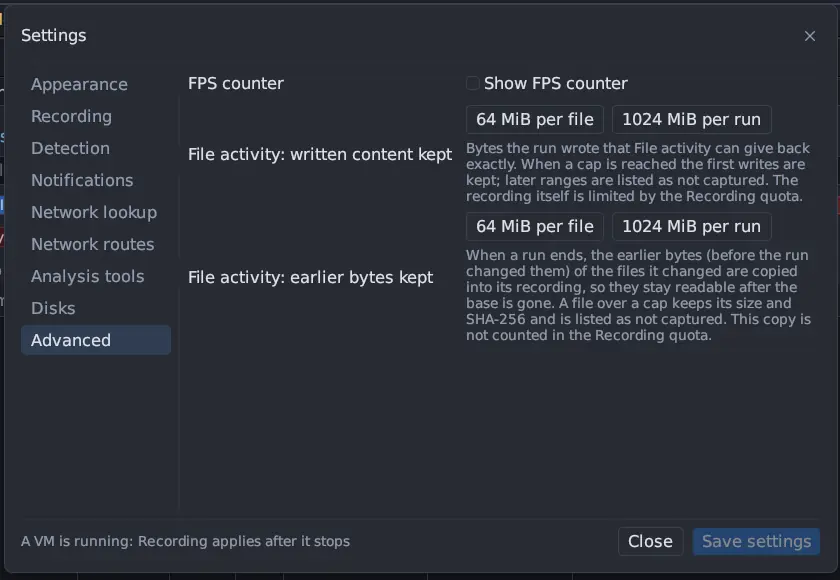
Section titled “File evidence and File Reconstruction”- Written content is kept within a budget. Every write the kernel captured reads back exactly from the recording, up to 64 MiB per file and 1 GiB per run by default (Settings › Advanced). Past a cap the first writes are kept and later ranges are listed as not captured.
- Earlier bytes of changed files. When a run ends, the bytes the changed files had before the run are copied into its recording from the disk the boot started from, so they stay readable after the base or a checkpoint is gone.
- Writes land where the kernel put them:
O_APPENDwrites, shared descriptors,sendfile,splice,copy_file_range, reflink clones,fallocateand writes through sharedmmapmappings. Needs a 0.8.0 base. - File Reconstruction replays a file’s reads, writes and resizes in the order the file system applied them and shows what each byte is known to be, step by step; it can hash a state and save it with a mask of unknown bytes.
See Files and File Reconstruction.
Cloud VPS profiles and stealth
Section titled “Cloud VPS profiles and stealth”- Cloud VPS preset. A VM can be an instance of Tencent Cloud CVM, Alibaba Cloud ECS, DigitalOcean Droplet or Vultr VC2: the provider’s firmware strings, chipset, virtio devices, MAC prefix and network, and a lived-in instance on the disk. On a Routed VM the gateway answers the provider’s metadata address with canary credentials that are new for each run, and Triage reports any use of them.
- About 40 real machines for the realistic presets, picked per VM and kept for its life, with every value taken from a public hardware report, and no QEMU strings left in the SMBIOS tables.
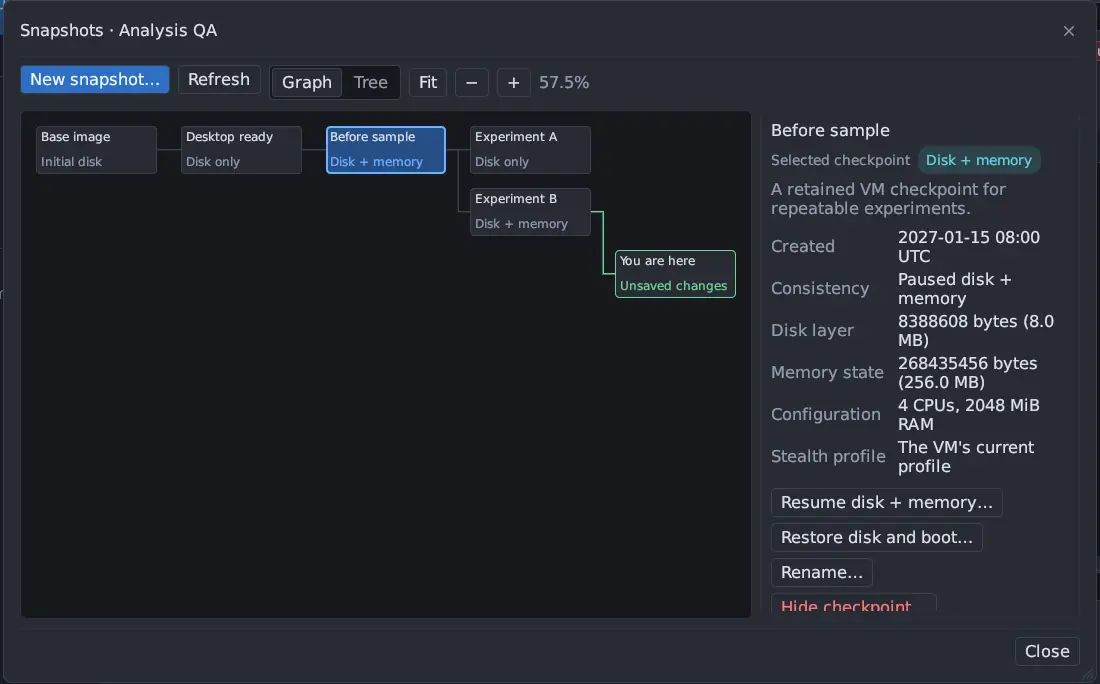
- Snapshots keep their stealth profile. Restoring under another profile offers Switch profile and restore.
See Cloud VPS profiles, Stealth profile and Snapshots.
Bases and the container builder
Section titled “Bases and the container builder”- Build base… builds where you choose: Automatic, Native, Podman, Docker or the QEMU builder. Podman and Docker build in a pinned Debian 13 container, so Debian Minimal gets Debian’s exact kernel banner on any host. A choice that cannot run says why.
- Debian Minimal looks more like an installed system: GRUB’s boot code, Debian’s kernel banner, an installed system’s initramfs, and a UEFI PC’s disk for a VM whose profile boots UEFI. Needs a 0.8.0 base.
- Guest kernels have BTF without the recorder’s names in it, as Debian’s kernel does. Needs a 0.8.0 base.
See Bases and the container builder.
Terminal Raw view
Section titled “Terminal Raw view”Each process terminal has a Formatted / Raw switch. Raw shows the byte stream with escapes written out, searchable and copyable, and highlights escapes that can hide output: cursor moves, line erases, overwrites, concealed text, control strings such as the OSC 52 clipboard command, and the alternate screen. Formatted now draws bold and italic. See Terminal.
Notifications
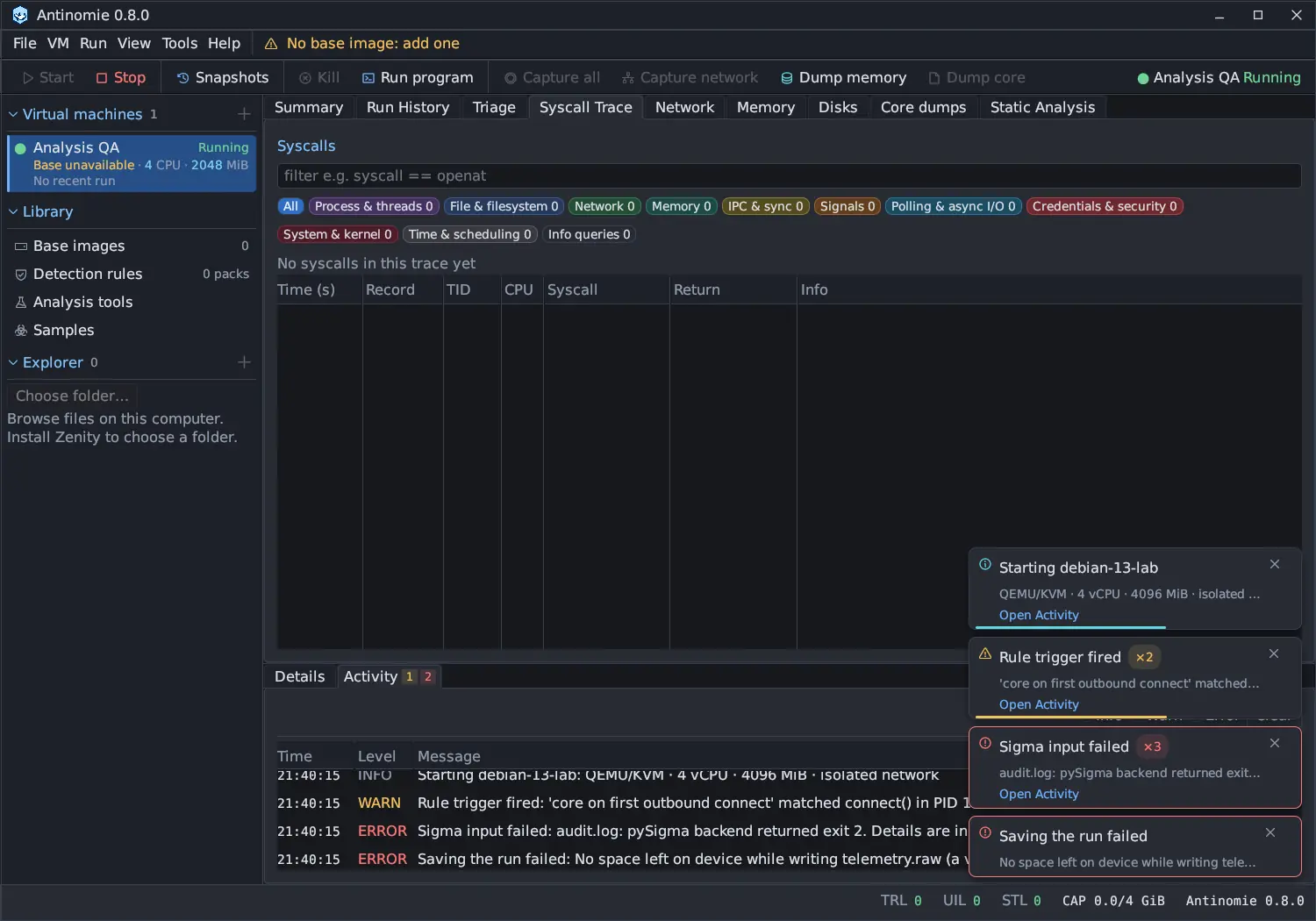
Section titled “Notifications”Toasts that close by themselves show their time left as a thin bar along the bottom edge; hovering pauses it. Settings › Notifications › Toast for live HIGH findings is now off by default.
Transport and recording reliability
Section titled “Transport and recording reliability”- A transport reconnect takes well under a second instead of waiting for the disk, and a command no longer times out before the guest could see it.
- Terminal output is no longer dropped on a busy screen.
- In Never drop, a waiting guest sender keeps its turn, so the host no longer loses records while it is still reading. Loss is reduced, not gone, and is still counted. Needs a 0.8.0 base.
- Summary › Health lists the host’s telemetry read gaps with their cause, so a guest drop can be tied to what held the host up.
- Starting a VM again before the previous boot’s recording is saved asks you to wait, and snapshot changes on a stopped VM wait for those saves, so the earlier bytes of changed files are not lost.
See Loss counters and Telemetry transport settings.
Syscall decoding
Section titled “Syscall decoding”Captured data reads by its type: strings are always quoted, data buffers are
quoted with every byte (binary bytes escaped), and structures, times, integers
and pointers show in hex. More structures are decoded by member: signal sets by
name, siginfo_t, sigevent, stack_t, bpf’s union bpf_attr by command,
capability headers and sets, directory entries, group lists, file_handle,
io_uring_params, System V messages, iptables headers and LDT entries. The
group lists, directory entries and LDT reads arrive typed only from a 0.8.0
base. Filter keywords cover every bpf command’s members.
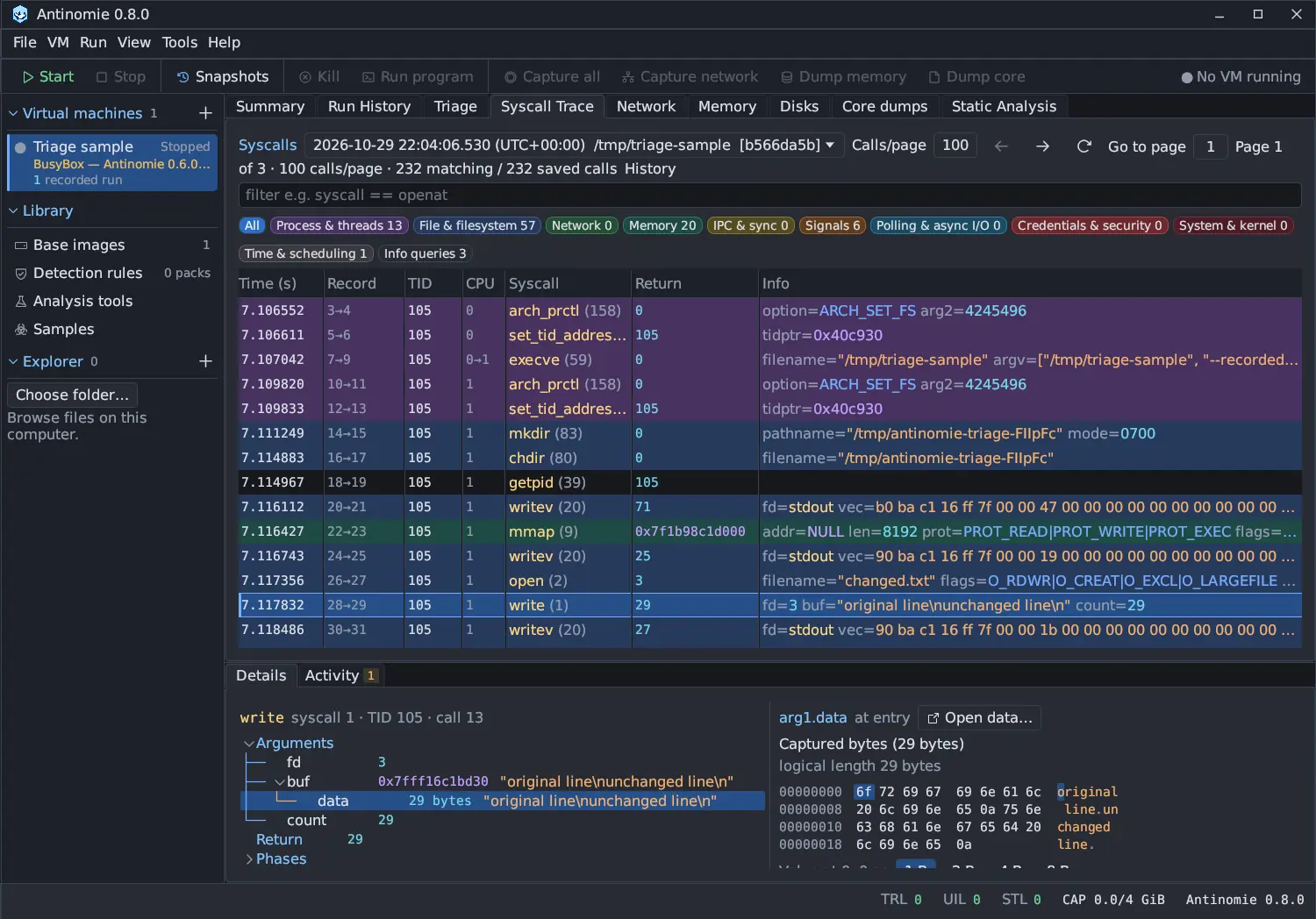
See Syscall Trace and The syscall inventory.