

Syscall Trace filter
The filter box on Syscall Trace accepts the shared syntax. A word with no operator searches the syscall name, TID, task and info text. For a saved recording the filter checks every saved call in a cancellable worker, so page counts and totals include matches beyond the first page.
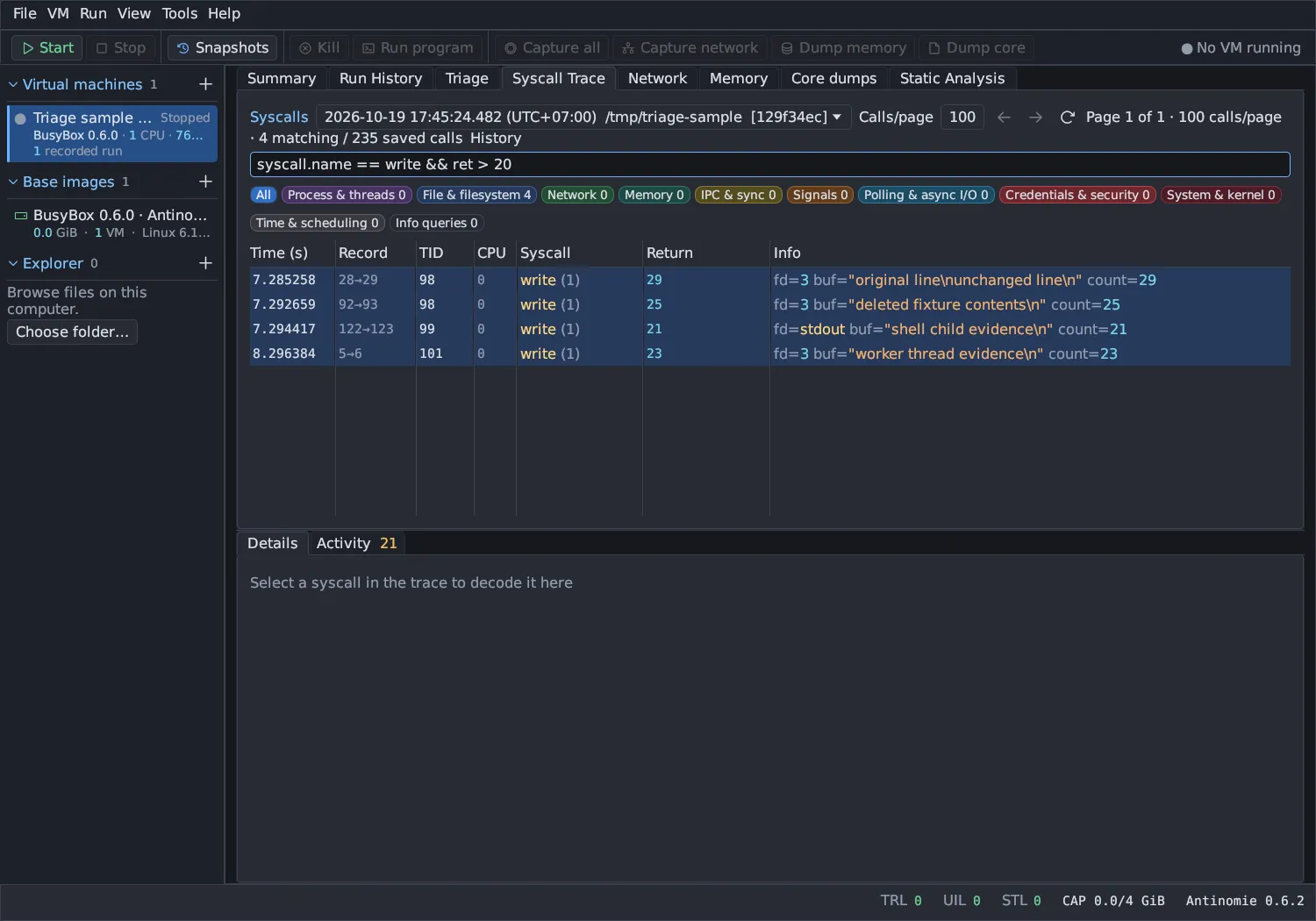
Fields are case-insensitive. Text compares are case-sensitive; use lower() to
ignore case.
Fields
Section titled “Fields”
| Field | Type | Meaning |
|---|---|---|
syscall.num |
integer | Native syscall number (alias syscall.number) |
syscall.name |
text | Syscall name (aliases syscall, name); case-sensitive in == |
syscall.group |
text | Syscall group, such as File & filesystem or Network |
ret |
integer | Exit result; missing when the exit was not recorded (aliases result, syscall.ret) |
syscall.errno |
integer | Positive errno for a Linux error return; missing on success |
syscall.success |
boolean | The result is not a Linux errno |
syscall.duration_ns |
integer | Exit minus entry guest time, in ns |
call.id |
integer | Invocation id (alias call_id) |
tid |
integer | Thread id (alias process.tid) |
pid |
integer | Process id (aliases process.pid, process.tgid) |
cpu |
integer | CPU recorded on the event |
task |
integer | Task cookie (aliases cookie, task.cookie, process.cookie) |
stream.id |
integer | Telemetry stream identity |
process.exe |
text | Executable path, on a call that committed an exec |
process.argv |
text list | Argument strings, on a call that committed an exec |
process.state |
text | exited for a call during which the task ended |
process.ppid, process.parent_cookie, process.uid, process.gid, process.comm |
integer, text | Per-task provenance. Missing on syscall rows in this version, so they never match. |
info |
text | The rendered Info column text |
event.id, event.sequence |
integer | Recorded event sequence |
event.time_ns |
integer | Guest monotonic time in ns |
event.complete |
boolean | All retained events of the call are complete |
event.gap |
text list | Recorded completeness issues |
Arguments
Section titled “Arguments”| Field | Type | Meaning |
|---|---|---|
args.0 to args.5 |
integer | Argument word by position |
args.raw[0] to args.raw[5] |
integer | The raw captured argument word; for a pointer argument this is the address |
args.<name> |
integer | Argument by its schema name for this call, such as fd, dirfd, flags, prot, addr, len, count. Signed C types (int, long, …) compare as signed. |
args.path |
text | Captured path, filename or pathname string, not the pointer. Aliases args.file, args.filename, args.pathname. |
args.old_path, args.new_path |
text | Captured old and new path strings (aliases args.oldname, args.newname) |
args.addr, args.len, args.prot, args.buf |
integer | Aliases for the address, length, protection and buffer argument (address, length, protection, buffer also work) |
args.<argument>.<member> |
integer, text, boolean | A member of a captured structure, such as args.how.flags for openat2’s open_how |
args.<argument>.complete, .captured_size, .expected_size, .status, .capture_error, .layout |
various | How completely the argument was captured |
Captured structures
Section titled “Captured structures”Every branch of bpf’s union bpf_attr is a keyword, qualified by the commands
that read it: args.attr.map_fd for the map element commands,
args.attr.query.attach_type for a query, args.attr.insn_cnt of a load,
args.attr.attach_bpf_fd and args.attr.attach_type of an attach,
args.attr.link_create.attach_type and so on. Before 0.8.0,
args.attr.attach_type of a BPF_PROG_ATTACH and args.attr.bpf_fd of a
BPF_OBJ_PIN read the word of a same-named member of another command. The
members of io_uring_params, group lists (gid_t[]) and xt_counters_info
have keywords too. Help → Filter guide and completion list them all.
Not available as keywords: the members of siginfo_t and sigevent (their
branch is selected by a member, not an argument), signal sets, and
ipt_replace. These are still shown decoded in the trace.
A path field is missing unless its string was captured. Structure members use
layouts checked against the pinned Linux 6.12.94 x86-64 headers, and a member is
missing when its layout, selector or phase is unsupported or ambiguous.
args.<argument>.status is the capture status number; see
Capture statuses.
Help → Filter guide lists every schema argument name, every syscall name and every structure member. Completion offers the same.
Examples
Section titled “Examples”syscall.name == openat && ret < 0syscall.name in {connect, sendto, sendmsg}syscall.group == "Network" && syscall.successexists(syscall.errno) && syscall.errno == 2args.prot & 7 == 7args.path contains "/etc/"lower(args.path) contains "ssh"args.fd == 1 && syscall.name == writeargs.how.flags & 0x40 != 0syscall.name == bpf && args.attr.map_fd == 4syscall.duration_ns > 1000000event.complete == falsemissing(ret)call.id == 1Left-click chips above the trace hide whole syscall groups, which narrows the list without a filter. See Syscall Trace.